Showing posts with label indian fiction in english. Show all posts

Monday, April 25, 2011

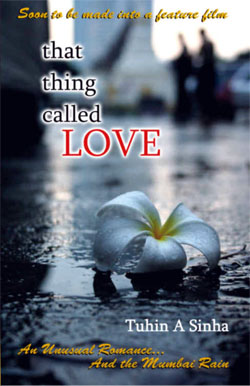
That thing called Love /Tuhin A Sinha.


Tuhin A Sinha's debut novel 'that thing called Love' has the magic of a Bollwood entertainer! The plot is gripping with lots of twists and turns to keep you completely engrossed in the flow of the story. The novel revolves around the lives of three friends, Mayank, Anil and Vishal, who work in a leading matrimony website. While Mayank is looking for a prospective bride for himself, the other two friends are married and have their own woes to deal with- Anil has a wife carrying the luggage of her past affair and Vishal gets a strange kick out of cheating on his wife. The complications grow when Mayank falls in love with a married, Revathi. The entangled relationships between different characters is what keeps one tied to the book. A vivid exploration of love, lust and marriage makes it a complicated study of the ever-changing urban psychology.

Besides, the skilful unjudgemental narration of the incidents and the responses of the characters to the different episodes in their lives, makes the novel, an interesting read. To add to the interest of the youthful souls, are abundant descriptions of passionate love scenes, though, I must say, they are an integral part of the plot. Sprinkled with lyrics from old Hindi songs and Urdu ghazals, the familiar TV serials and movies, the fictitious world almost comes alive before us. 

 One such quotation aptly adds to the relationship between Mayank and his love interest in the story-

"Taruf rog ho jaye to usko bhulna behtar,
Taluk bojh ban jaye to usko todana achcha
Woh afsana jise anjaam tak lana na ho mumkin,
Use ek khubsurat mod dekar chhodna achcha."

Tuesday, April 5, 2011

That Long Silence/ Shashi Deshpande

  • That Long Silence

Shashi Deshpande is perhaps ideally suited to tread the labyrinthine tracts of human pysche and creditably represents it in her fiction. Her novels, particularly 'The Dark Holds No Terrors' and 'That Long Silence' - are an education in the psyche of people who lose their capacity for rational thought on being subjected to traumatic experiences.

The novel is about Jaya Kulkarni, an apparently satisfied housewife. Having married a responsible man, Mohan, and blessed with two children, Rahul and Rati, and a home and material comforts, she seems to have almost nothing to ask for in life. However, to achieve this stage of fulfilment, Jaya has systematically suppressed every aspect of her personality that refused to fit into her image as wife and mother. Two such most important aspects are : her writing career and her friendship with Kamat.

Deshpande has adopted the stream-of-consciousness technique which helps her to successfully bring out the inner workings of the mind of characters. A smooth lenear development of the narrative would not have facilitated the two and fro movement in time of Jaya's consciousness. The use of this technique reminds us of Dorothy Richardson's 'Pilgrimage' in that there is significant assertion of autbiographical undercurrents in the novel.

Thus, the novel is about how Jaya accepts her boundaries and then moves on to redefine her relation with the world. Her psychology is probed and we witness anxiety of how she would respond to the situation she finds herself in.

A book recommended for all..but do not expect it to be like a fiction or story...it is more like some aquaintance baring her heart and life before you.